Duress alarm systems: instant help during critical emergencies

Trusted by 100,000+ organizations globally
Safety and security are growing concerns across personal and public properties, as incidents and threats continue to increase in homes, businesses, schools and offices. This rise in volatility has led to a higher volume of requests for emergency assistance, underscoring the critical need for enhanced protective measures across all sectors. For example, a 2023 report outlined that over 80% of nurses in the healthcare industry also faced some form of verbal abuse or physical violence, alongside increasing incidents in educational settings, which raised serious questions about the protection of staff and students.
In response to these growing security concerns, duress alarm systems, often referred to as panic buttons, have seen a surge in adoption. A duress alarm system is designed to accelerate incident response times and ensure a safer working and living environment for individuals. This comprehensive guide provides detailed insight into duress alarm systems and their potential to significantly enhance any organization’s security infrastructure and emergency response capability.

Deploy Rave for fast safety alerts
- Instantly contacts 911 and security staff
- Sends facility data and floor plans
- Speeds up emergency response times
- Integrates with cameras and access control
What is a duress alarm system?
A duress alarm system is a fixed or wearable panic button designed to enhance the protection of individuals. They are generally silent and used to discreetly request immediate assistance.
The need for a duress alarm can arise in many situations: when an older adult triggers an alarm to request immediate assistance, when a retail employee is threatened by a customer or in the event of an escalating situation on a school campus, prompting a security response.
A typical duress alarm system consists of:
- Trigger point: A button, which can be a fixed device (e.g., under a desk) or a wearable device (e.g., a necklace or badge).
- Supporting software or hardware: Receives the alert and immediately notifies and directs the security team to the person activating the button.
These systems can be discreetly installed almost everywhere within a premises to provide a direct, instant connection between individuals and active security or emergency personnel.
How does a duress alarm work?
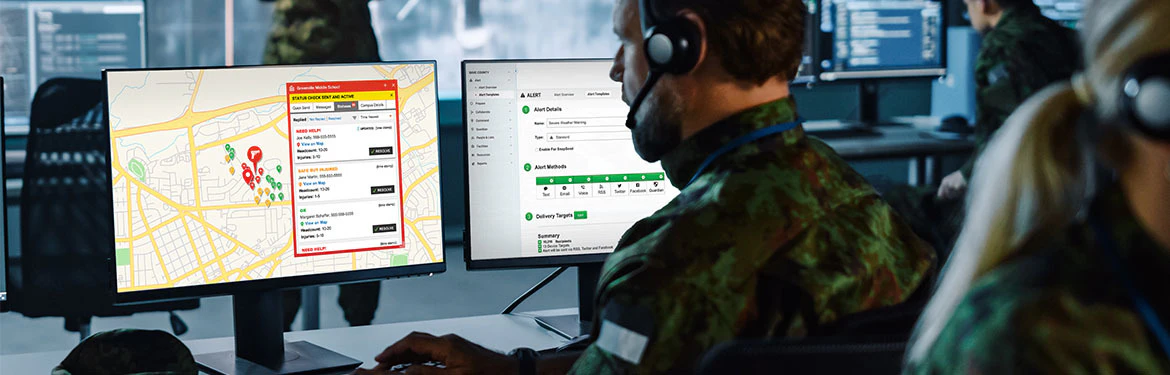
Duress alarms work through a straightforward, three-point approach: the individual with the device, the mediating system and the response team. Understanding how a duress alarm works highlights its efficiency in critical moments.
Here’s a breakdown of how duress alarms generally function:
- Trigger: An individual feeling threatened or requiring assistance activates their closest panic button or device.
- Alert: A silent duress alarm signal is instantly sent to a security station, dispatch center or designated response team.
- Response: Security teams are notified of the precise trigger location, prompting immediate mobilization and response to the alarm point to address the incident.
Scenarios for duress alarms
The versatility of a duress alarm allows for varied use cases across different environments:
- Assisted living: An older person in an assisted living center might have a fall, pressing the wearable button to instantly alert staff that they need assistance.
- Industrial safety: An employee handling hazardous materials in an industrial facility might trigger a panic button in the event of a chemical spill to alert the appropriate emergency response team.
- Retail and finance: Employees facing an aggressive customer or intrusion can discreetly activate a duress alarm to summon security without alerting the aggressor.
What are the different types of duress alert solutions?
While all duress alert solutions share the core purpose of instant and discreet alerting, they differ in form factor and application. This allows organizations to select the best option for their security infrastructure.
Here are the three main types of devices that make up a duress system:
- Portable or wearable: Devices that individuals can carry on their person or wear as a badge, pendant or watch. They offer flexibility and are ideal for people who are constantly moving within a large facility.
- Fixed: These alarms are secured to a designated area or item within the premises. Typical places for fixed duress alarms include under office desks, reception areas and near cash-handling machines or rooms containing sensitive information.
- Mobile (wireless): These portable solutions integrate into smartphones or are standalone devices that access wireless networks. Wireless duress alarm systems often feature GPS functions to enable security teams to locate a person more accurately when the user activates the button.
Where are duress systems used?
Duress systems have a broad range of applications across prominent industries due to their intuitive design and instant notification capabilities.
Below are some leading examples of duress system usage:
Healthcare
Hospitals, clinics and assisted living centers use duress alarms extensively to protect vulnerable staff and patients from violent or aggressive incidents. Implementing these duress systems has led to reports of significant reductions in aggressive behavior, providing staff with a reliable way to call for backup during critical moments or medical emergencies.
Education
The escalating number of security incidents in educational facilities underscores the critical need for school safety solutions, such as duress systems, that can instantly alert security personnel and external authorities. In many jurisdictions, the installation of these panic buttons is now required to comply with specific safety regulations like Alyssa’s Law.
Finance and retail
Employees in financial centers or retail stores face unique security risks, including theft and aggression during cash handling. They can use a discreet duress alert solution, often in the form of a fixed button installed under counters, to instantly and silently notify authorities or security teams during a robbery attempt or aggressive encounter without escalating the threat.
Hospitality
Venues that serve alcoholic beverages and large hotels have heightened security needs due to unpredictable patron behavior and high guest volumes. Staff can utilize fixed panic alarms behind bars or in service areas to quickly alert security personnel to aggressive patrons, maintain order and protect customer and employee safety.
Transport
Airports, train stations and bus terminals face increased security risks due to high passenger volumes and potential threats. On-site security teams can deploy and activate duress alarms to quickly communicate and alert local authorities, enabling a coordinated and rapid response to a volatile situation in crowded public areas.
What are the benefits of a duress assist alert system?
A duress assist alert system offers numerous benefits to the safety and security of people living and working within facilities. Organizations can minimize disruptions and potential damage by ensuring a quick and effective response.
Here are some of the core benefits of installing a duress assist alert system:
- Swift incident response: The system provides a simple, direct trigger point that instantly transmits the alert. This immediate notification ensures responsible personnel receive an urgent request for assistance, enabling a swift response directly to the incident location.
- Deterrence: Knowing that a silent duress alarm system is active in a premises may deter potential intruders or aggressors from causing a security incident.
- Improved overall safety: The accessible level of support and faster response times help improve the overall workplace safety and security around a facility.
- Regulatory compliance: Certain local regulatory frameworks, such as the New York Retail Worker Safety Act, require employers to provide their staff with silent panic response buttons.
- Staff security and peace of mind: Individuals working in particularly volatile areas can feel more assured of their personal protection on the job, knowing help is only a button-press away.
How duress alarms integrate with existing security systems
While duress systems traditionally operated as standalone devices, modern solutions are often designed to play an integral role in a premises’ overall security strategy.
Here’s how modern duress alarms can integrate into a facility’s existing security infrastructure:
- Video security cameras: Integration allows response teams to quickly obtain visual confirmation of an incident upon receiving a panic button system alert, verifying the need for a duress alert solution response.
- Access control: Duress alarms can be integrated with access control systems to trigger simultaneous lockdowns or restricted entry/exit protocols when activated.
- Notification systems: They integrate into communication software to instantly share notifications of triggered panic buttons across relevant security teams.
- Data analytics: Integrated systems can collect data about device usage, frequency and response factors, which helps security designers improve a facility’s overall security strategy.

Get your 2025 guide to security technology
- Latest security challenges facing businesses
- The current state of the security tech industry
- Top security technology trends of 2025
- Expert insight for security infrastructure planning
Choosing and implementing your duress system
Choosing the right duress system can be challenging, as many factors are unique to a facility’s specific circumstances. By following a structured approach, you can select and implement the ideal duress assist alert system.
Here are five key steps to help choose and implement a duress alarm system:
1. Consider the use cases
Determine how different types of duress alert solutions will benefit your specific environment. For example, if staff are constantly on the move, a wearable solution is ideal. If a threat is localized (e.g., a cash register), a fixed alarm is better.
2. Ensure system integration
Check that your chosen duress system can integrate easily with your existing security infrastructure, especially legacy systems.
3. Evaluate cost and budget
The duress alarm system price is a primary concern for many organizations. Ensure the costs align with your budget by considering the Total Cost of Ownership (TCO), which includes installation, recurring software fees and maintenance for items like wireless duress alarm systems.
4. Check regulatory compliance
Some jurisdictions have regulatory frameworks. Check your local laws to ensure that your chosen system, including features like GPS-enabled wireless duress alarm systems, complies with all mandates.
5. Evaluate scalability
Ensure the system can easily scale to meet future physical security needs. Your infrastructure should be adaptable to cover broader areas or accommodate operational changes.
Conclusion: Elevate your emergency response with a duress alarm system
Duress alarm systems are simple in function but play a vital role in improving security for individuals and businesses. Their versatile applications, intuitive user experience and instant communication capabilities provide faster response times to incidents, giving staff and occupants peace of mind in their safety.
Adopting a duress alarm system can significantly elevate your incident response capabilities and create a more robust security network within your facilities. For organizations seeking a comprehensive and adaptable solution, Avigilon’s advanced commercial security systems, including its integrated access control and video management software, offers a reputable path to enhanced safety to meet the needs for scalability and instant communication outlined in this guide.
Duress alarm system FAQs
Have questions? We can help
Our video security experts can help you implement the right security system for your business.